It's not long now before we all bunker down with our families for the holidays, and we just wanted to wish everyone a fantastic time, and a great new year as well. We've had great fun in the Undercover team this year, and are looking forward to more trailers, author sneak peeks and shenanigans next year.
Our Christmas present to you is a little peek at the location used in the Daylight Saving trailer. This is one of the most exciting young adult books out next year, from a new talent in fiction. Here's a little about the book...
When Daniel Lever is dragged to Leisure World Holiday Complex for some "time away" with his depressed dad, his expectations are low. Daniel is overweight, he hates sport, and his father has brought along his beloved tomato plant. But soon Daniel spots a girl swimming in the fake lake. Lexi is elegant and smart, but very mysterious. Why are her bruises getting worse each time she and Daniel meet? And is her watch really ticking backwards? A dark figure stalks the pair, and as British summer time approaches, Daniel has to act quickly. Their souls depend on it.
Our trailer focuses on the first meeting between Daniel and Lexi, and was filmed earlier in the week on Hampstead Heath - here are a couple of shots of the location.
What do you think? The perfect location for a ghost thriller? We'll be releasing the trailer early in january, so keep an eye out...
The Undercover team, signing off. Happy Holidays everyone!
The end of the year is (frighteningly) nearly upon us.
And what a crazy year it's been. Since we launched the Undercover blog, we've driven round London in white vans delivering books to schools; we ran a blog hunt for extra Cassie Clare material, and have a number of blog tours under our belt. Plus, a couple of the Undercover team had their acting debut along with Peter Cocks in the Long Reach trailer.
But it's all paid off, because Undercover is continuing in 2012, and we're going to be developing the blog into a fully fledged website, which is pretty exciting!
BUT...before we let our creative juices run away from us, we'd love to know what you would like to see on the Undercover site. Any thoughts on how it should look, what sort of areas you'd like to see? Messageboards, competition areas, etc?
We'd also love to know what sort of content you're interested in. Do you like our trailers? Do you want more digital covers, like the Daylight Saving one? More countdown clocks, or other nifty widgets you can embed and share?
Lastly, what sort of things would you like to see us writing about on the blog next year? More behind the scenes posts from authors? How about a bit more from our editors, cover designers, publicists and marketeers about everything that goes into making and promoting books.
Simply comment on this post to let us know your thoughts. Anyone who does so before 22nd December will be thrown into a prize draw for a copy of an Undercover book of your choice!
Competition Rules
* One entry per person. Multiple entries will be deleted.
* Open to UK and Ireland residents only.
* One winner will be picked at random.
* Contest closes 22nd December 2011
* The winner will be announced within 1 month of closing.
* For full terms and conditions, visit our website.
Last night the judges announced the shortlist for the 2011 Costa Children's Book Award.
There are four books on the shortlist, two of them are from Walker Books, and one of them is our very own Undercover read, FLIP!
The other Walker Book on the shortlist is The Unforgotten Coat by Frank Cottrell Boyce, a stunning magical story of a summer of friendship with darker undertones of the plight of refugees. To find out more about this book, visit the walker website.
If you haven't already, watch our trailer for FLIP, or read the first chapter. You could also check out our behind the scenes posts with Martyn Bedford
Today, in fact right this second, the clocks are going back an hour. For most of us, this is a fantastic day as it means we get an extra hour to stay wrapped under the duvet, safe in our beds. But for one of the main characters in Edward Hogan's debut young adult novel, Daylight Saving, this time of year brings nothing but fear...
Intrigued? We don't want to reveal too much about the book, but it's a thriller ghost story by a new voice in YA fiction that will have you utterly gripped. We can also tell you that this very night, when the clocks go back, is one that fills the characters with dread.
To countdown to publication in February, we've created an animated version of the cover, complete with a countdown clock. Drag your mouse over it to really see the full effects.
It's completely shareable, so you can send it to your friends and place it on your own website too.
What do you think of it? It's the first time we've launched an animated cover of this kind, we'd love to hear what you think about the cover and the book concept? Leave a comment below for your chance to win a very early proof copy of the book.
Shadowhunter fans were in for a real treat yesterday at Cassandra Clare's London event. 150 fans gathered in the gallery at Foyles to hear her in conversation with Sarah Rees Brennan...
After the event, the pair of authors signed books for a few hours. The queue wound right around the store and we had 400 people in total. This, Foyles told us, was more than when Anne Rice was signing there, which is amazing! Check out these photos of the queue and of Cassie signing - we love the glittery skull...
This morning (27th October) Cassie jetted over to Ireland for an event at 6 p.m. at Eason in Dublin - this event is sold out, but you can meet her at Eason on Shop Street, Galway, on the 28th October at 4 p.m. to sign copies of City of Fallen Angels and the brand new boxset of the first three Mortal Instruments books...
If anyone's still unsure about Clockwork Prince, the first edition in the UK and Ireland, out 6th December, is a Collector's Edition that will contain a letter from Will to his family, (that he never sent), as well as a short story called "Burning Bright", which tells the story from Jem's point of view of how he first met Tessa.
Obviously it's nearly impossible to guarantee that anyone will get the first edition, but as long as you pre-order or buy Clockwork Prince within the first week or so, you will almost certainly get your hands on it. It won't matter where you pre-order or buy it from. If you’re buying in a bookshop, tell them you want to pre-order a first edition. If you’re buying online, check the picture when you’re ordering. If the cover says “Collector's Edition” then that's the right one.
If you don't manage to get your hands on the Collector's Edition, don't worry - Cassie always puts online extras up on her website a few months after publication. You'll have to wait a little longer, but you won't miss out!
Cassandra Clare is in the UK! We welcomed her to London this morning with a very British breakfast at the Walker offices (tea and coffee with bacon sarnies, strawberries, pineapple and chocolate brownies...)
It was a great start to what will be a very busy day. Cassandra Clare's event at Foyles this afternoon was sold out within hours of the tickets being released, but you can still get a copy of your books signed by Cassandra Clare from 2.30 p.m. in the children's department, on the ground floor of Foyles, Charing Cross Road. But if you are going to the event, we'd love to hear from you on twitter: just tweet @WalkerBooksUK.
We also had an opportunity to make a few videos of Cassandra whilst she's over, including a reading from the hotly anticipated Clockwork Prince, which we let you see once the book is released... All of the videos we made, including some fun Shadowhunter Top Trumps questions, will go up here on Undercover in the following weeks...
Clockwork Prince is out on December 6th in the UK and Ireland - the same date as the US, Australia, New Zealand and Canada, which is very exciting as it means that fans from all these countries will be able to read the books at the same time.
There are a number of different editions flying around depending on where you are, but in the UK and Ireland, the first edition of Clockwork Prince is an extra special collectors edition, that has the
letter that Will Herondale writes in Clockwork Angeland the short story, "Burning Bright". All of these short stories always go up on Cassandra Clare's blog around three months after publication, so no matter what you will be able to read them, but if you want to read them right away be sure to get a copy of the first edition, which is available to pre-order now.
If you're not from the UK and Ireland, take a look at Cassandra Clare's website to find out more about the different editions...
In the meantime, there are some teasers for Clockwork Prince up on her blog which you can read here.
More exciting news is that the cover for City of Lost Souls, book 5 in the Mortal Instruments, will be unveiled in December. You can see the official placeholder image above. Any thoughts on what the cover might feature?
If you're completely new to Cassandra Clare, you can watch this teaser trailer for Clockwork Angel... it's the first book in the Infernal Devices, her prequel trilogy to The Mortal Instruments. You can also find out more about both series at www.mortalinstruments.com/
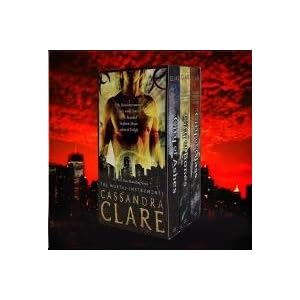
This month, we've also released a pretty stunning boxset of all three of the first Mortal Instruments books, which is the perfect way to throw yourself into the world of Shadowhunters and Downworlders... you can buy it here.
If that isn't enough, Cassandra Clare has also written a short story for an anthology of fantastically rich and strange stories: Steampunk is out now, and there are stories from some great authors, including Garth Nix, Holly Black and Kelly Link. To celebrate this amazing anthology, we've released one of the short stories as a free ebook, so keep your eyes peeled for Clockwork Fagin by Cory Doctorow on the Kindle Store. You can also buy Steampunk here
When we released the trailer for the amazing Shadows on the Moon by Zoe Marriott in June, she made a promise - that when the trailer had 1,000 views she would upload an extended version of it. We passed 1,000 views last week, so here it is, the uncut version!
If you haven't seen the original yet, or need to remind yourselves what it was like, here it is as well...
Which is your favourite? Comment on this post to let us know...
Joanna Nadin has written a fantastic little guest post for us about how she came up with the main characters for her latest novel, Paradise.
I knew her only vaguely. Billie, I mean. That she was a girl who had been raised In London – Peckham, where I had spent thirteen years – who was then transplanted, airlifted from that teeming, dirty-pavement, all-night city, with all its infinite possibility, to the crowding, claustrophobic Cornwall of my childhood memories. Not to the picture postcard technicolour template of a hot August holiday, but to the bleak, ever-raining February, when every day is like Sunday, and Sundays never end. To a Paradise lost.
I had a sketch of her in my head. But, like Billie’s faint line drawing of her may-be father, there were so many pieces, features missing. I tried flicking through the faces of teenage friends, of TV actresses in my head, like a rail in TopShop, waiting to find one that fit. I tried picturing myself as Billie – because in the end, all our heroines and heroes are a part of us. But it was just that, a part. Just an awkwardness. She was too tall, too ethereal, too cool to be me.
But then I saw her. Trudging along St Saviour’s Road in a rain-soaked school uniform, her hair clinging to her face in tendrils: dark, like her eyes and face. Carrying a guitar and an art folder. My Billie. And from that moment she came alive.
But Danny, he was easy. The boys always are. Like Ed in Wonderland, and others before him, he was a redrawing of my first love, or crush, at least.
Pennington he was called.
I still remember him in stark detail. The way his hair curled over his collar, defying school rules, and endless and pointless detentions from masters. His hands stuck stubbornly, sulkily in his pockets. Then the way they would come to life at the piano, dancing up and down the ivory as he practised the Liszt.
He was seventeen, a dishevelled tortured soul. And I was younger: fourteen, too young, really. But old enough to know that this was true love. That I was the only person who understood him. His moods, his genius. Ruth claimed to. But I knew deep down she wasn’t the one. I was.
If only he could see that. If only he could see me. If only he were, well, real.
But then again, if he had been, would he have been as perfect? If he’d been on the bus to Peterborough Ice Disco, would he have sat next to me? Or would he have fallen for Karen: captain of the netball team, and owner of not one but three ra-ra skirts.
I’ll never forget him. The way he made me (and hundreds more) feel. The way I still feel when I flick through the pages of KM Peyton’s ‘Beethoven Medal’.
That’s what I wanted for Danny. So his hands on the piano, his hair curling long over his collar, his possibility, all belonged to Pennington first. But they fit Danny perfectly. They are his alone now. And yours.
Paradise is out now, available wherever books are sold, and also as an ebook. You can also read an extract here, and watch the book trailer below. You can buy the book at the Walker website
Teased by Tantalize? Possessed by Eternal? Then prepare yourself to be Blessed in Cynthia Leitich-Smith's latest dark fantasy...
Quincie Morris, teen restaurateur and neophyte vampire, is in the fight of her life.
Even as she adjusts to her new appetites, she must clear her best friend and true love, the hybrid-werewolf Kieren, of murder charges; thwart the apocalyptic ambitions of Bradley Sanguini, the seductive vampire-chef who "blessed" her; and keep her dead parents' restaurant up and running.
She hires a more homespun chef and adds the preternaturally beautiful Zachary to her waiting staff. But with hundreds of new vampires on the rise and Bradley off assuming the powers of Dracula Prime, Zachary soon reveals his true nature -- and a flaming sword -- and they hit the road to staunch the bloodshed before it's too late. Even if they save the world, will there be time left to salvage Quincie's soul?
Cynthia Leitich Smith has written a little about her inspirations behind her dark fantasy series below...
I’m in the thrall of the dark master.
In the year 2000, I opened a word processing document and, without much thought, gave it the working title “Brad: The Impaler,” a clear play on the moniker of the famed historical Vlad, a long-ago prince of Wallachia known for having impaled his enemies.
I’ve since read disputing accounts as to whether Vlad actually inspired Bram Stoker’s title character in Dracula (1897), but at the time I hadn’t yet begun to do my homework and there was much of it to do.
I wanted to write the kind of book I loved most. I’ve always enjoyed spooky stories. I read a lot of Stephen King and Dean Koontz. I watched TV shows like “Friday the 13th” and “Tales from the Crypt.” I enjoyed movies like “Lost Boys” and “Teen Witch.”
I'd already begun watching Joss Whedon’s “Buffy: The Vampire Slayer” TV series and adored the take-back-the-night/hell-school-is-hell themes as well as the way it blended horror, romance and comedy in a multi-creature-verse with strong (though by no means invulnerable) characters of both genders.
Then it was time for me, research-wise, to kick it old school. This was well before the paranormal trend in YA literature, so I started with the few YA Gothics and worked all the way back to Stoker.
What with its foreboding themes and atmosphere, I could appreciate how the novel Dracula had survived into modern day and why it had been reinterpreted so many times.
I decided to assume that it was loosely based on truth and extend the tradition to a present day setting. I created Quincie P. Morris, a many-times great niece of one of Stoker’s vampire hunters (Quincey P. Morris), a gallant Texan, and as a nod to that character, largely centred the action in Austin, Texas, which I call home.
The Tantalize series, and especially Blessed, is a literary mystery, a tribute to Stoker’s leading fiend, as well as a Whedon-esque rescue-the-boy, destroy-the-monster, save-the-world story. Blessed blends heartfelt romance and sensual temptation with horror, humor, and suspense. The story even invites the dark master back on stage, so to speak, and pits him against modern YA heroes—all with their own inner monsters, but nevertheless fighting with an angel on their side.
Sound intrigued? Well, watch our latest trailer for a glimpse of what happens to Billy Paradise when her Grandmother leaves her a house in Joanna Nadin's compelling new novel.
We love how this trailer's turned out. It's really atmospheric, the cinematography is stunning, and there are several interesting locations including the hubub of central London and the windy shores of a seaside.
For your chance to win a copy of this book, watch the trailer and tell us what you think of it on twitter @WalkerBooksUK #Paradise before 5p.m. on friday 9th September.
John Cusick, author of Girl Parts, has lived on both sides of the publishing world, starting as a literary agent before getting published Girl Parts published, first in the US and now here, by us. In this guest blog post, he lets us know a little about what it's like and gives his top tips for budding authors...
Speaking of metaphor, Petey was an apt one for what I hoped to become. Agents can seem like fanged gatekeepers, blocking the entry to literary success. I didn’t know what lay beyond the big dog, and neither do most writers. Getting past doesn’t mean getting published. In fact an agent’s inbox is just the beginning of the fraught, uncanny journey to the bookstore. I know this well. Now that I’m an agent, I read dozens of queries a day— vetting, culling, and mostly rejecting. I crumple with prejudice. I delete with a vengeance. But I’m also a writer, and know what it’s like to send a query hoping someone will discover my talent. It’s a Jeckle & Hyde identity— part fiendish rejecter, part doe-eyed scribbler.
Writer-agents aren’t unheard of, though my situation is a bit unique, as my agent is also my boss. Not long after starting at STNY, Scott suggested I write something for teens. Solicited? Woot! I’d have a book deal by Christmas. Right?
…Right?
Writing young adult after four years studying 19th century novels wasn’t easy. I couldn’t hide behind complex literary tricks or sweeping description. I had to tell a good story. Period. My characters would have to do things, not just sit around feeling and thinking. Feeling blocked, I flew to L.A. to attend the Book Expo America on behalf of STNY. Landing at LAX, I glanced out the window and saw a city where I knew virtually no one. I thought of the first day of school, when everyone seems to be friends but you. And then BAM I had it. My story was about isolation, feeling alone in a crowd. I opened my lap top and started typing furiously— just in time to hear, “Excuse me sir, you’ll need to stow that.”
Four months later I presented my manuscript, and immediately wished my agent didn’t read literally ten feet from my desk. As Scott read, I tried to concentrate on work, jumping out of my seat whenever he went “Hmm.” This went on for days (an eye-blink compared to most agency turn-around times), Scott scribbling in the margins, me grinding the enamel from my teeth. I knew to expect notes, but wasn’t prepared for anything so exhaustive. Scott said he had “some thoughts”: My story was set in the future. Scott suggested a contemporary setting. It was told in the present-tense. He wanted simple past. It was in the first person. It should be in third. And that was just the beginning.
Getting notes is like being punched in the nose and saying, “Thanks!” Revision is resetting the bone. It hurts. But I was lucky. Not only did Scott hold my hand through months of rewrites, everyday I saw our clients— veteran writers— take their notes and go back to work, rethinking, refining, and polishing. Without their example I’d have despaired. More than ever, agents develop manuscripts before submitting— editors can’t risk purchasing underdeveloped material— but it still shocked me how many drafts any manuscript undergoes before it’s acquired, let alone hits the shelves.
At last my manuscript, Girl Parts, was ready to submit. Scott hand-picked a list of editors, and the waiting began. I learned to fear the sound of Scott’s email alert and his sigh “Oh well.” More distracting than rejection was the eventual interest from three major houses. There were a few awkward moments when editors called for Scott and got me instead. It was like an Abbot and Costello routine:
Editor: Is John willing to discuss edits?
Me: I am, sure.
Editor: No, John.
Me: I’m John.
Editor: No, no. John the author.
Me: Yes. That’s me. I’m the author.
Editor: Oh! I’m sorry, John. I thought I dialled STNY.
And so on.
When at last we accepted an offer from Candlewick, I helped negotiate my own contract, a privilege few authors are afforded. I’d aided Scott on dozens of contracts, but the fine print looked much different when it was my name on the signatory line. Then came my editor’s notes, and jacket design, and marketing…but that’s all the fun stuff.
With the emphasis on creative development in MFA and undergrad programs and critique groups, writers aren’t always aware of what to expect from the agenting process. As an agent and author I’ve had a crash course in the business of getting published, and so here are six things I wish someone had told me:
1. Your first book probably won’t get published.
One of STNY’s authors has for jacket copy: “This is not Mr. Scrimger’s first novel; but it is the first one anyone apart from his wife has liked.”
It’s sad but true. Writing something saleable (and by this I mean not just artistically coherent but marketable) takes practice, and most authors have a few unsold first-tries lurking in a drawer somewhere. The good news for first-timers: the pressure is off. Experiment. Type (or scribble) with impunity! Consider your first novel a warm-up, part classroom, part playground. Down the line you may even return and cull great things from it—or better yet, revise and publish! But don’t get discouraged if first time isn’t the charm. In the words of Beckett: “Try again. Fail again. Fail better.”
2. Writing “The End” is far from the end.
I wrote my first novel in college on a Smith Corona Electric (just for fun), and typing “The End” at the bottom of page 300, I felt I’d just climbed Everest. There it was, my book, all seven pounds of it. A work of flawless genius. Finito. Months later an agent friend sent me a three-page letter of editorial suggestions, and I nearly stroked. “But the book is done,” I whined. “You want me to change it?”
I didn’t understand that the first draft is step one on a long journey of revision that can take months or even years. I had the gist on paper, now it was time to dig deeper, enrich my characters, their motivation and psychology, the reality of the story’s world, everything.
Agents assume writers are willing (and eager) to revise. Even best selling authors with awards coming out their ears go through draft after draft. Some writers freak after receiving their first critique from an agent or editor, when they should be popping champagne. STNY rarely sends notes to writers without (in our opinion) potential. Criticism means interest, or at least a measure of respect in your talent. Moreover, notes are a grad school creative writing course for the price of an S.A.S.E. Value them!
3. Let the work speak for itself.
An author once sent chocolate chip cookies with her query. That author instantly became my best friend forever. But, as far as I know, she remains unpublished.
I look for three things in a query, in this order: Firstly, did the author follow our guidelines? It may seem picky, but it’s a litmus test of professionalism. Secondly, I look for a strong, coherent story concept. If it’s too familiar, or too generic (i.e. “loner kid comes of age and struggles with bullies and first love”), I know we’ll have trouble selling it. Finally, I look for superlative writing— exquisitely fresh observation, ingenious details and a startling voice. Professionalism, strong story, strong writing. That’s what I (and I think all agents) look for.
It’s true that agents read thousands of queries a year, and it’s important to stand out: but stand by being a desirable author with a great story and strong writing. Believe me, that’s enough! Avoid colourful fonts, gimmicky ideas, and presents. Also, professional websites, business cards and fancy letterhead may look cool, but they won’t save a boring story.
4. A good idea is better than good writing, but you need both.
I hear it everywhere. Editors, agents, librarians and booksellers are all looking for “high-concept” books. What makes a book “high-concept?” If the central idea of the story is clear, precise, and unique, it’s probably “high-concept.” Lauren McLaughlin’s Cycler is an excellent example: Every time a girl has her period, she transforms into a boy. BAM. That is different, easy to grasp (conceptually if not scientifically), and get sour imagination spinning before we read the first page. Note too that Cycler's concept can be described in a brief sentence. Learning to distill your story into its basic element this way is an important skill.
Is concept more important than strong writing? No, but it will get your foot in the door, as most agents read query letters before sample pages. And strong writing rarely sells a book. This fact is oft lamented in our office: sometimes a truly talented writer can’t get published because his or her stories are just, well, boring.
5. Follow your muse, not the trends.
Boy, I wish I’d written a vampire book back in 2006. Instead I was writing about dinosaurs. Oh well. Trends are difficult to anticipate, even for industry professionals. Trying to follow them rarely succeeds. By the time your book is finished, chances are editors’ lists are already saturated with zombie-pirate-mysteries, or whatever the next hot thing is. Your best bet is to follow your muse. Write what inspires you, what moves you, what you can write truthfully and with personal understanding.
That said, you probably have more than one good idea, and it doesn’t hurt to pick the most market-friendly. Look for what’s out there, and what isn’t. The other day Scott said to me, “You should write a novel set in the roaring twenties. No-one’s done that lately.” Next day, Going Bovine author Libba Bray signed a seven-figure deal for just such a series. Whoops, we were too late. But she certainly wasn’t, and I’m willing to wager Ms. Bray had a dozen worthy ideas and chose one that was market-friendly.
6. It’s not impossible!
My grandmother once told me, “John, surviving a hand grenade going off in your hat is a miracle. Getting published happens everyday.” She was right. Work hard, keep at it, be smart, be ready to give yourself entirely to your work, and chances are you will either A) realize you have better things to do, or B) get published. It’s not impossible. It happens everyday. And remember, there’s an entire industry of professional bookmakers out there who truly want you to be the next J.K. Rowling.
Ignore those who say it’s hard. You know that already. Ignore those who say there’s no money in it. They’re right, and it doesn’t matter. You’re a writer. You’d write stories if you lived alone on a desert island, using the bark of coconut trees for paper. Forget the naysayers, listen and appreciate criticism, and keep at it every day.
Girl Partsauthor John M. Cusick has given us a behind the scenes glimpse into the world behind his funny, witty and prescient debut novel.
What happens when teenagers spend so much time online that they become completely disconnected from real life?
The booktakes a look at internet culture and our craving for meaningful connection in an uber connected world. Find out more about Sakora, the company that features in his novel, below...
Introducing Sakora…
Solutions for Life!
Sakora Solutions is "a wellness company, specializing in behavioral therapy, pharmaceuticals, and cybernetics."
About Sakora Solutions’ Companion Program
In our digital age, electronic distractions increasingly devalue, demean, and replace interpersonal relationships. Forty-percent of young adults experience chronic feelings of disassociation, discomfort, and depression. Cases of anhedonia, moral apathy, and even suicide are on the rise. Studies have shown that young men ages thirteen to seventeen are particularly at risk.
That’s why there’s Sakora Solutions’ Companion Program. You can find out more about Sakora in this short informative video, or skip it and read their FAQ below...
COMPANION PROGRAM FAQ “Love must be relearned.” Coleo Foridae, Founder and President.
What is a Companion?
A Companion is an advanced cybernetic android, a teaching tool, a learning machine, a trusted confidant, and a beloved friend. Designed to mimic, learn, and modify human behavior, the Companion is the most advanced non-invasive, non-narcotic therapeutic device ever conceived, making it the ideal tool for human development, from treating disorders to inspiring personal growth. At once less and more than human, a Companion is humanity’s helpmate for the new millennium.
How does the Companion Program work?
The Companion Program treats conditions like Dissociative Disorder by teaching empathic human connection. Accounting for the power of the adolescent male libido, the Program utilizes operant conditioning (or “punishment and reward”) to discourage dehumanizing behavior and reinforce relationship development.
Is the Companion Program right for me?
Presently, the Companion Program is proscribed for sufferers of Dissociative Disorder and similar conditions. If you currently or have ever experienced feelings of disconnection, emotional flatness, self-consciousness, uncertainty, depression, isolation, or dissatisfaction, ask your doctor about Sakora’s Companion Program.
Caution:
· Patients with preexisting heart-conditions should not participate in the Companion Program.
· Patients suffering from epilepsy or who have a family history of strobe-induced seizures should not participate.
· Patients with pacemakers, metallic bone pins or metallic fillings are strongly discouraged from participating in the Companion Program.
What is an Intimacy Clock?
Your Companion’s Intimacy Clock measures the growth of your empathic connection to your Companion over time. As your relationship deepens— through communication, shared experience, and mutual understanding— more intimate forms of physical connection become available.
Simply put, the Intimacy Clock is a countdown. After one minute with your Companion, a handshake may be appropriate; after thirty-days, a long hug or a kiss. Individual countdowns will vary.
The Intimacy Clock discourages precipitous and inappropriate physical contact by administering a gentle electronic pulse, disrupting communication between the brain and the voluntary muscles (see disclaimer).
What is the ABC Protocol?
Your Companion has access to nearly a million logographical and encyclopedic entries, including a vast database of non-verbal facial and body language cues. But she still has a lot to learn!
Because our language is always changing, Companions are not programmed with slang or technical jargon. Sakora’s ABC Protocol allows your Companion to “learn” words and phrases much as an infant does, gradually developing more colloquial speech.
Does my Companion really “love” me?
Your Companion experiences an intense, involuntary desire to be near you and experience your happiness, manifesting in physiological symptoms identical to “love.” At the electrochemical level, there is little difference between human love and your Companion’s “feelings” toward you.
What happens to my Companion once the Program is complete?
Retired Companions are “decommissioned” in one of Sakora’s humane rendering facilities.
Are there boy Companions?
Sakora Solutions is constantly expanding to embrace new platforms and provide a wider selection of products and services.
Disclaimer:
In clinical trials a small number of test subjects experienced reoccurring rashes, muscle twitches, and temporary paralysis or blindness. Some patients may experience prolonged agalmatophilia or technosexuality after completing the Companion Program. In rare cases, attachment to electronic objects such as toasters, cellular telephones and switching stations occurred. Common side effects include nausea, dry mouth, priapism or “persistent erection.” Profuse sweating, disorientation, palpitations and other symptoms associated with “Debilitating Infatuation Syndrome” may also occur.